
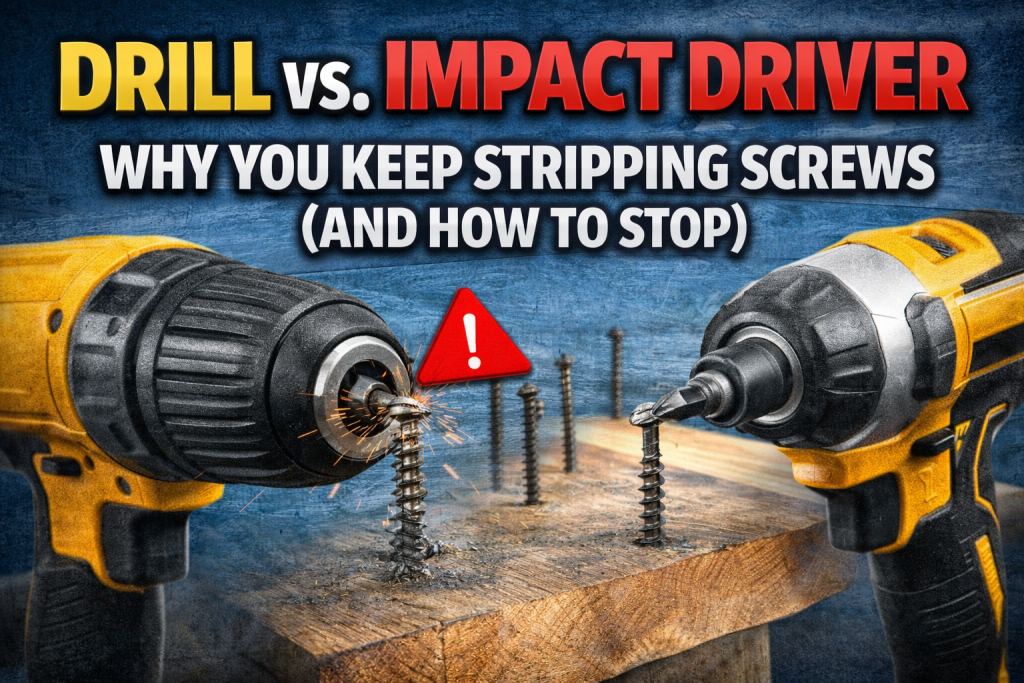
Stripped screws can ruin momentum in any DIY or woodworking project. You start strong, the screw goes halfway in, then the bit slips and the head gets damaged. The frustration builds quickly because it feels like a skill problem, when in reality it is often a tool mismatch.
Understanding the difference between a drill and an impact driver is one of the most important lessons for beginners. Once you know how each tool behaves under pressure, projects become easier, faster, and far less stressful.
Table of Contents
The moment every DIYer experiences
It usually happens when driving a long screw into lumber. The resistance increases, the drill starts fighting back, and suddenly the bit slips. The screw head is now stripped and difficult to remove. Your wrist feels the torque and the project slows down.
This situation is extremely common and it does not mean you are doing something wrong. It simply means the tool being used is not designed for that level of resistance.
Why stripped screws happen so often
Screws strip because the bit loses grip inside the screw head. As resistance increases, smooth rotation becomes less effective and slipping begins. The damage happens in seconds and often feels unavoidable.
Typical causes include:
-
Driving screws into dense lumber
-
Using the wrong bit size
-
Applying too much speed
-
Skipping pilot holes
The biggest cause, however, is using a drill for heavy fastening instead of an impact driver.
Drill vs impact driver: the core difference
At a glance, drills and impact drivers appear similar, but internally they operate very differently. A drill provides steady, continuous rotation and relies on a clutch to manage torque. This makes it excellent for drilling holes and handling precision tasks.
An impact driver adds rotational hammering when resistance increases. Instead of struggling with constant torque, it delivers bursts of force that keep the bit locked into the screw head. This allows screws to drive deeper with less slipping and less effort.
The real purpose of a drill
A drill is primarily a hole-making tool. It excels at controlled, accurate work and provides better handling for lighter fastening. It is ideal for tasks where finesse matters more than power.
Situations where a drill performs best include:
-
Drilling pilot holes before installing screws
-
Working with thin materials
-
Using hole saws or spade bits
-
Installing small hardware
These tasks require precision and consistent rotation rather than aggressive torque.
The real purpose of an impact driver
An impact driver is designed specifically for fastening under resistance. When pressure increases, it shifts from smooth rotation to rapid hammering motion. This action prevents slipping and keeps the bit seated firmly.
It becomes especially useful during projects like deck building, framing, and installing long structural screws. The tool handles resistance automatically, reducing strain and improving speed.
Understanding cam-out and why it matters
Cam-out is the technical term for when a bit slips out of a screw head. It happens when the torque needed to turn the screw becomes greater than the grip between the bit and the screw.
As a screw moves deeper into wood, friction builds. A drill continues spinning smoothly, but eventually the resistance forces the bit upward. Once slipping starts, the screw head is quickly damaged.
This is not a mistake in technique. It is a mechanical limit of constant rotation tools.
Why impact drivers reduce cam-out
Impact drivers react to resistance rather than fighting it. When the screw becomes harder to drive, the internal mechanism delivers short bursts of rotational force. This keeps the bit seated deeper inside the screw head and reduces slipping.
The result is cleaner screw installation, less frustration, and fewer damaged fasteners.
When to choose a drill
There are situations where a drill remains the better option. Precision tasks and hole-making rely on smooth control and consistent rotation.
A drill is more suitable when:
-
Creating pilot holes
-
Drilling through metal or plastic
-
Assembling furniture
-
Working with delicate materials
These tasks benefit from controlled torque rather than impact force.
When to choose an impact driver
An impact driver becomes essential when resistance increases and screws need to be driven securely. It simplifies fastening and reduces the chance of stripping.
It performs best when:
-
Driving long wood screws
-
Building structural frames
-
Installing deck boards
-
Removing stubborn bolts
In these cases, the hammering motion makes the work significantly easier.
The role of screw type and bit selection
Not all screws behave the same. Screw head design affects how well the bit stays seated. A poor match between bit and screw increases slipping and accelerates wear.
Bit fit matters more than many people realize. Even a powerful tool cannot prevent stripping if the bit does not lock tightly into the screw head. Understanding different screw head styles helps prevent this issue, and the guide at /phillips-screwdriver-vs-flathead/ explains how these designs influence grip.
Real-world woodworking scenarios
The difference between tools becomes clearer during actual builds. Softwood may allow a drill to perform acceptably, but hardwood quickly reveals its limitations. Resistance increases, slipping becomes more likely, and fatigue builds.
An impact driver handles these situations with more consistency. The tool adapts automatically to resistance and keeps the screw moving forward without constant pressure.
How professionals use both tools together
Experienced builders rarely rely on only one tool. A common approach is to use a drill for preparation and an impact driver for fastening.
This workflow improves efficiency and reduces errors. Pilot holes lower resistance, and the impact driver finishes the job cleanly.
Signs you need an impact driver
If projects often involve stripped screws, wrist strain, or slow progress, upgrading tools may be necessary. Repeated slipping, difficulty driving long screws, and frequent bit wear are clear indicators that a drill is being pushed beyond its intended purpose.
Beginner mistakes that increase stripping
Stripping often results from small habits that are easy to overlook. Driving too fast, forcing screws without pilot holes, and using worn bits all increase the risk. Paying attention to control and preparation makes a noticeable difference.
The long-term advantage of using the right tool
Choosing the correct tool improves more than just speed. It protects materials, reduces fatigue, and creates cleaner finishes. Projects feel smoother and confidence grows as tasks become easier to manage.
Over time, the combination of a drill for holes and an impact driver for screws becomes the standard setup for most DIYers.
Final takeaway
Stripped screws are rarely caused by lack of skill. Most of the time, they happen because a drill is being used where an impact driver is needed. Understanding how each tool works removes frustration and leads to better results.
A drill remains essential for drilling and precision tasks. An impact driver excels at driving screws and handling resistance. Using both tools correctly transforms the way projects feel and the quality of the final outcome.
